

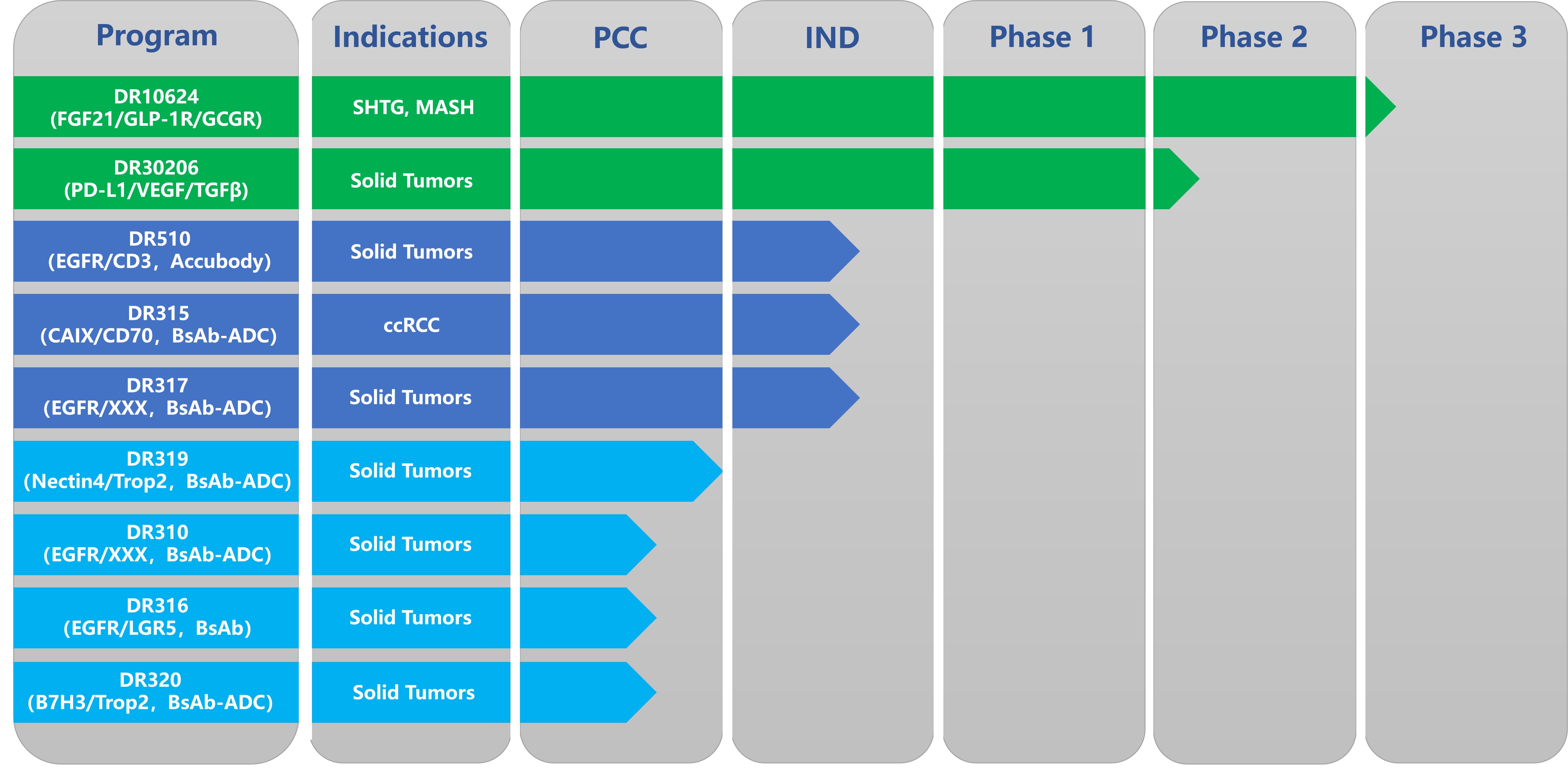
DR10624 is an innovative "triple-target" fusion protein built on the MultipleBody® (multi-domain) technology platform. By fusing FGF21 analogues, GCG/GLP-1 dual -effect hybrid polypeptide with the Fc segment of human IgG1 antibody, and simultaneously activating FGF21 receptor (FGF21R), glucagon receptor (GCGR), and glucagon-like peptide 1 receptor (GLP-1R), a multi-dimensional collaborative intervention for metabolic diseases is achieved. DR10624 received approval for clinical trials in New Zealand in April 2022 and in China in July 2023 respectively. The Phase II clinical study of SHTG has been completed, and multiple Phase II clinical studies including MASLD and DKD are currently underway. The Phase II SHTG study results were presented as a keynote opening report at the 2025 American Heart Association (AHA) Annual Meeting. Data indicates that DR10624 demonstrates excellent efficacy, not only rapidly and sustainably reducing triglyceride levels after the first dose but also effectively optimizing the atherogenic lipid profile, increasing adiponectin levels to improve insulin sensitivity, and providing multiple metabolic benefits including weight reduction and lowering uric acid. Due to its favorable safety profile and potential protective value for organs such as the heart, kidneys, and liver, DR10624 has been included in the Breakthrough Therapy Designation list by the Center for Drug Evaluation (CDE) of the National Medical Products Administration (NMPA). The first Phase III clinical trial (for the SHTG indication) has been initiated, offering promise for a more comprehensive and effective treatment option for patients with SHTG, mixed hyperlipidemia, and metabolic dysfunction-associated steatohepatitis (MASH).
DR30206 is a trispecific fusion protein targeting PD-L1, VEGF, and TGF-β. It targets three distinct key pathways, aiming to reactivate the body's anti-tumor response from different dimensions: Firstly, tumor cells highly express PD-L1 (programmed death-ligand 1), which binds to PD-1 (programmed death-1) highly expressed on T cells in the tumor microenvironment (TME), triggering negative feedback that inhibits T cell activation, proliferation, and cytokine secretion, leading to ineffective anti-tumor immune responses. DR30206 blocks the PD-1/PD-L1 pathway, directly lifting the tumor's immunosuppression of T cells, reactivating exhausted T cells, and enhancing their anti-tumor immune response capability. Secondly, vascular endothelial growth factor (VEGF) is a key factor promoting tumor angiogenesis. By blocking this pathway, DR30206 can effectively reduce the formation of new tumor blood vessels and promote normalization of abnormal tumor vasculature. Thirdly, transforming growth factor-beta (TGF-β) is a core immunosuppressive factor in the TME (Tumor Microenvironment), inducing fibrotic barriers and inhibiting immune cell function to create a "cold tumor" microenvironment. By binding and blocking TGF-β, DR30206 has the potential to transform "cold tumors" into "hot tumors", improving the response rate to DR30206 treatment. Clinical trials for DR30206 in China were approved in June 2023, and multiple Phase Ib and IIa studies for non-small cell lung cancer, head and neck squamous cell carcinoma, colorectal cancer, etc., are currently ongoing.
DR510 is a prodrug-type T-cell engager (TCE) developed based on Doer Bio's proprietary Accubody® (Precision Therapy) technology platform. It simultaneously targets the epidermal growth factor receptor (EGFR) on tumor cells and the CD3 molecule on T cells, directing cytotoxic T cells to the vicinity of tumor cells and activating them to form an artificial immune synapse, releasing perforin and granzymes to kill tumor cells. Through high-throughput screening technology, a tumor microenvironment-specific protease-cleavable substrate linker was obtained and tandemly linked with a specific alpaca single-domain antibody that neutralizes CD3 binding activity as an activity-masking domain (VHH masking domain, VHHm), enabling precise activation in the tumor microenvironment. Furthermore, the ingenious design of a single-enzyme cleavage dual-masking structure, through steric hindrance, effectively reduces the binding activity of the TCE to normal tissues, thereby addressing issues such as on-target, off-tumor toxicity and cytokine release syndrome (cytokine storm). Unlike most similar TCE-type Prodrugs, the Accubody® technology platform does not require screening masking peptides for the tumor antigen binding site to achieve dual masking of both the tumor antigen and the CD3-targeting antibody simultaneously. Preclinical research results indicate that DR510's unique dual-masking design achieves a crucial balance between efficacy and safety, effectively inhibiting tumor cell growth while showing no significant damage to normal tissues. The intended clinical use of DR510 is for the treatment of various EGFR-high expressing solid tumors such as non-small cell lung cancer (NSCLC), head and neck squamous cell carcinoma, and colorectal cancer.
DR315 is a dual-target antibody-drug conjugate (ADC) targeting CA9 and CD70. DR315 leverages the characteristic of extremely low co-expression of CA9 and CD70 in normal tissues versus high expression on cancer cells. Through bispecific antibody-mediated specific binding, it effectively addresses the severe hematological toxicity commonly seen in clinical trials of CD70-targeted monoclonal antibody ADCs, significantly improving drug safety. DR315 employs a novel cleavable hydrophilic linker and is armed with a DNA topoisomerase I inhibitor (Topo1i) as the payload, interfering with the normal function of topoisomerase, causing unrepaired DNA double-strand or single-strand breaks in cancer cells, leading to halted cell replication and induced apoptosis. Preclinical pharmacological and toxicological results show that DR315 has a potent killing effect on tumor cells, while in pre-toxicology experiments in non-human primates (NHPs), DR315 exhibited a favorable safety profile. The intended clinical indication for DR315 is clear cell renal cell carcinoma (ccRCC) and other CA9/CD70 double-positive solid tumors.
DR317 is a dual-target antibody-drug conjugate (ADC) targeting EGFR and XXX (undisclosed target), intended for the treatment of various solid tumors, particularly non-small cell lung cancer resistant to third-generation tyrosine kinase inhibitors (TKIs) and ovarian cancer that develops resistance after platinum-based chemotherapy. By modulating antibody affinity, DR317 significantly improves selectivity for tumor cells expressing both EGFR and XXX targets, reducing damage to normal tissue cells. DR317 also uses a novel cleavable hydrophilic linker and is armed with a DNA topoisomerase I inhibitor (Topo1i) as the payload. DR317 possesses a potent bystander effect, killing neighboring cancer cells that do not express or express low levels of the target, thereby thoroughly addressing the issue of incomplete clearance due to intratumoral heterogeneity. In multiple preclinical tumor xenograft model experiments, DR317 demonstrated outstanding tumor suppression capability. In pre-toxicology experiments in non-human primates, DR317 showed good tolerability with no severe toxic side effects observed. The intended clinical use of DR317 is for various EGFR-positive, refractory solid tumors following resistance to front-line therapies.
DR10627 targets GLP-1 (glucagon-like peptide-1), GIP (glucose-dependent insulinotropic polypeptide), and GCG (glucagon), which are key regulators of energy metabolism in the body. Based on high-throughput sequence optimization and screening, DR10627 is a peptide with triple-target agonist activity for the GLP-1 receptor (GLP-1R), GIP receptor (GIPR), and GCG receptor (GCGR). It further covalently conjugated with a long-chain fatty acid to bind serum albumin, with the aim of prolonging the in vivo half-life, reducing dosing frequency, and improving patient compliance. The three targets of DR10627 work synergistically: GLP-1 promotes insulin secretion, suppresses appetite, and delays gastric emptying; GIP synergizes in lowering blood glucose and may improve fat metabolism while reducing gastrointestinal side effects associated with GLP-1; GCG further enhances the regulatory effect by increasing energy expenditure (thermogenesis) and promoting hepatic lipolysis. In preclinical animal studies, DR10627 demonstrated extremely significant blood glucose control and weight loss effects, superior to some dual-target controls. The intended clinical indications for DR10627 are obesity and diabetes. It received approval for clinical trials in January 2022. The Phase I clinical study has been completed, preliminarily verifying human safety and pharmacokinetic characteristics.
DR10628 is developed based on high-throughput sequence optimization and screening, resulting in a peptide with dual-target agonist activity for both the GLP-1 receptor (GLP-1R) and the GIP receptor (GIPR). It further covalently conjugated with a long-chain fatty acid to bind serum albumin, with the aim of prolonging the in vivo half-life, reducing dosing frequency, and improving patient compliance. The dual targets of DR10628 work synergistically: GLP-1 promotes insulin secretion, suppresses appetite, and delays gastric emptying; GIP synergizes in lowering blood glucose and may improve fat metabolism while reducing gastrointestinal side effects associated with GLP-1. In preclinical animal studies, DR10628 demonstrated extremely significant effects in reducing blood glucose and body weight. The intended clinical indications for DR10628 are obesity, diabetes, and metabolic dysfunction-associated steatohepatitis (MASH). It received approval for clinical trials in April 2023. The Phase I clinical study has been completed, preliminarily completing the verification of human safety and pharmacokinetic characteristics.