
At the 2026 AACR Annual Meeting, Zhejiang Doer Biologics Co., Ltd. (hereinafter referred to as "Doer Bio") presented preclinical data for DR319-DP, a first-in-class Nectin-4/Trop-2 bispecific bipayload antibody-drug conjugate (ADC) co-developed with Glyco-therapy Biotechnology Co., Ltd. (hereinafter referred to as "Glyco-therapy").
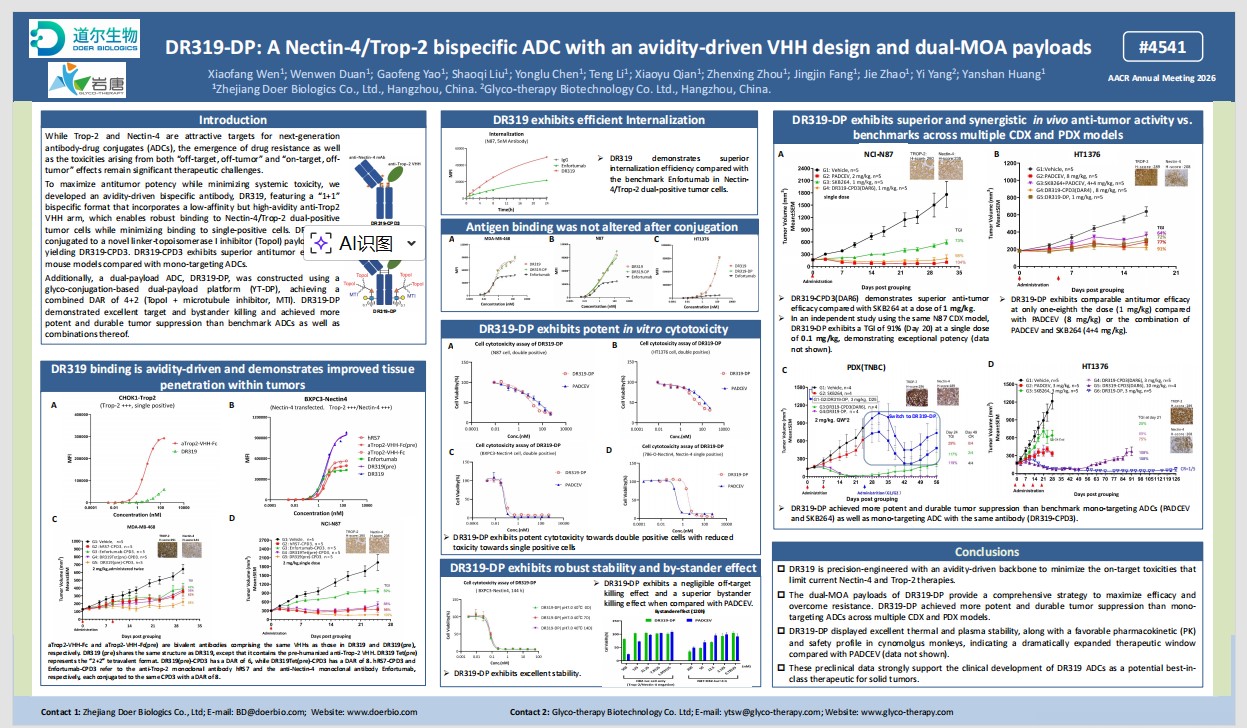
Trop-2 and Nectin-4 are popular targets in the current ADC landscape, but their clinical application still faces bottlenecks such as frequent drug resistance and a narrow therapeutic window. Furthermore, as Nectin-4 and Trop-2 exhibit some expression in normal skin and ocular tissues (with Trop-2 showing relatively higher expression), traditional ADCs targeting Trop-2 and Nectin-4 also face challenges related to on-target/off-tumor toxicity.
To address these issues, Doer Bio and Glyco-therapy have combined a "1+1" bispecific antibody architecture with the glycosite-specific dual-payload conjugation platform YT-DP to create a next-generation bispecific bipayload ADC, DR319-DP (Trop2/Nectin-4 bispecific antibody, TOP1i/DAR4 + MMAE/DAR2), which demonstrates high specificity, high efficacy, and low toxicity.
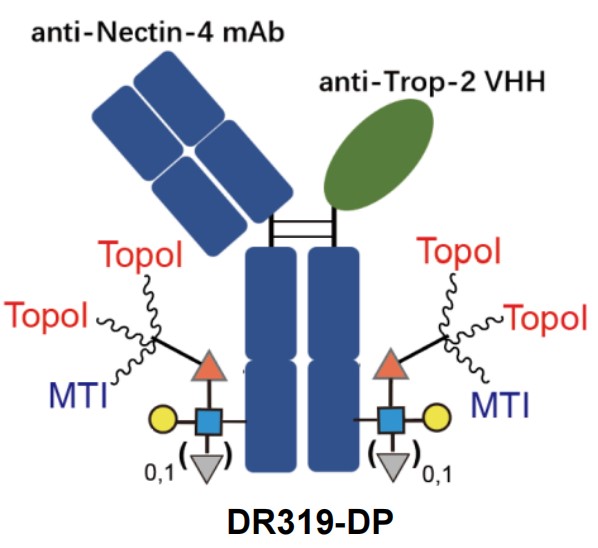
Schematic Diagram of DR319-DP Molecular Structure
-
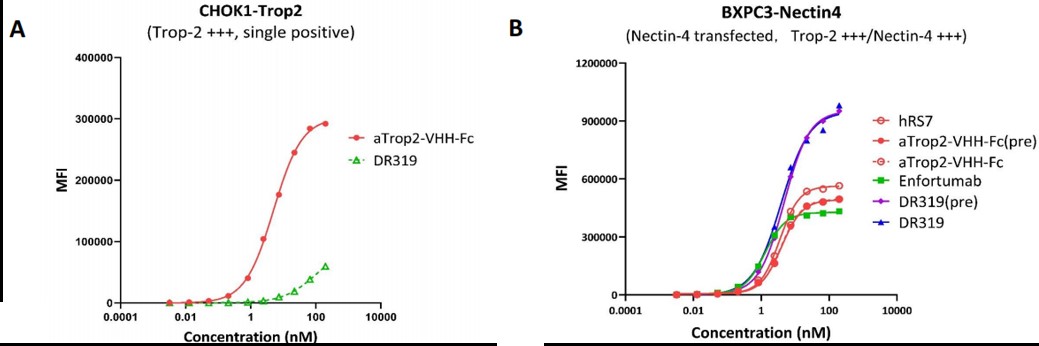
The antibody component of DR319-DP, named DR319, features a "1+1" structure composed of an Avidity-driven anti-Trop-2 VHH (low affinity/high avidity) and an anti-Nectin-4 monoclonal antibody. This design enhances binding to Nectin‑4/Trop‑2 double-positive tumor cells while significantly reducing on-target/off-tumor binding to single-positive cells.
-
DR319 demonstrates potent internalization on Nectin‑4/Trop‑2 double-positive cells, significantly superior to Enfortumab.

-
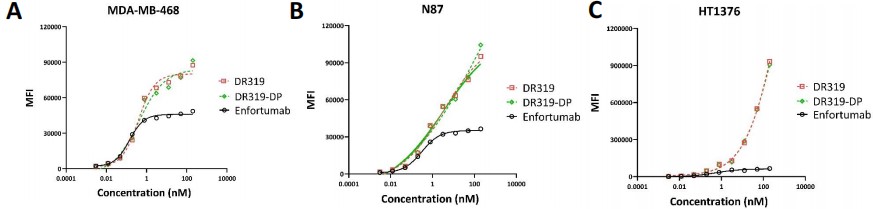
DR319-DP exhibits similar affinity to its unconjugated antibody counterpart, DR319.
-
DR319‑DP shows potent cytotoxic activity against Nectin‑4/Trop‑2 double-positive cells, while its activity is significantly attenuated against Nectin-4 single-positive cells.

-
DR319‑DP demonstrates superior bystander killing activity compared to PADCEV.

-
DR319‑DP exhibits excellent in vitro stability.

-
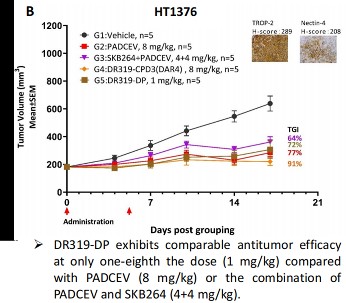
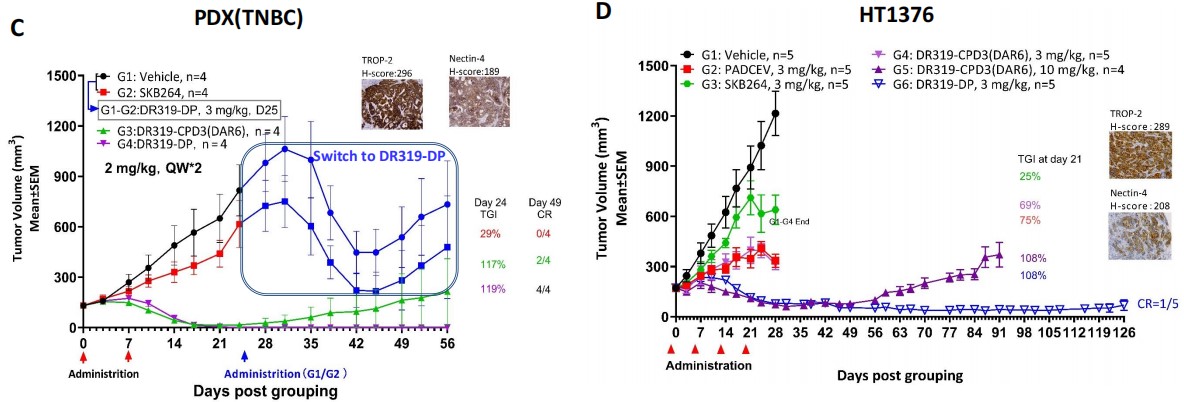
DR319‑DP demonstrates potent and durable antitumor activity in multiple mouse models.
In various mouse cell-line-derived xenograft (CDX) and patient-derived xenograft (PDX) models, DR319-DP consistently showed potent and durable antitumor activity. At a dose of 1 mg/kg, DR319-DP achieved tumor inhibition comparable to that of PADCEV at 8 mg/kg and the combination of PADCEV (4 mg/kg) + SKB264 (4 mg/kg). Furthermore, DR319-DP showed significant advantages over an ADC conjugated with a single TOP1i payload (DR319-CPD3). Remarkably, a single administration of DR319-DP led to significant regression of large established tumors (TNBC PDX model). Additionally, in cynomolgus monkeys, rats, and immunodeficient mice, DR319-DP demonstrated a longer half-life and superior pharmacokinetic properties compared to DR319-CPD3 and PADCEV (data not shown).
The poster presentation on DR319-DP attracted significant attention and interest from attendees at the AACR 2026 meeting. Dr. Junfang Xu, Chief Medical Officer of Huadong Medicine, Dr. Yi Yang, Chief Executive Officer of Glyco-therapy, and Dr. Yongliang Fang, Chief Operating Officer of Doer Bio, were present at the poster to showcase DR319-DP and engage in in-depth discussions with participants.


The preclinical data presented at AACR 2026 suggest that DR319‑DP comprehensively outperforms traditional single-target or single-payload ADCs in terms of precision, efficacy, safety, and potential to overcome resistance, demonstrating promising clinical development potential. It holds the promise of becoming a best-in-class bispecific bipayload ADC for a broad range of solid tumors in the future.